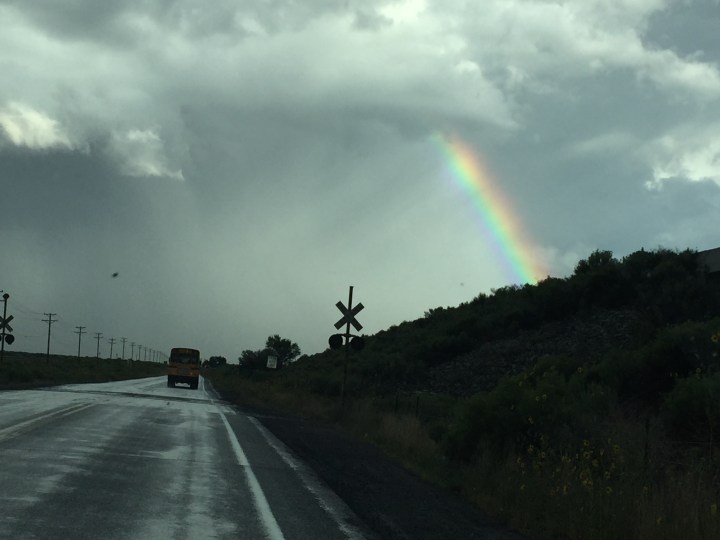
As I drive to work, Ben Webster plays
My Funny Valentine on sax.
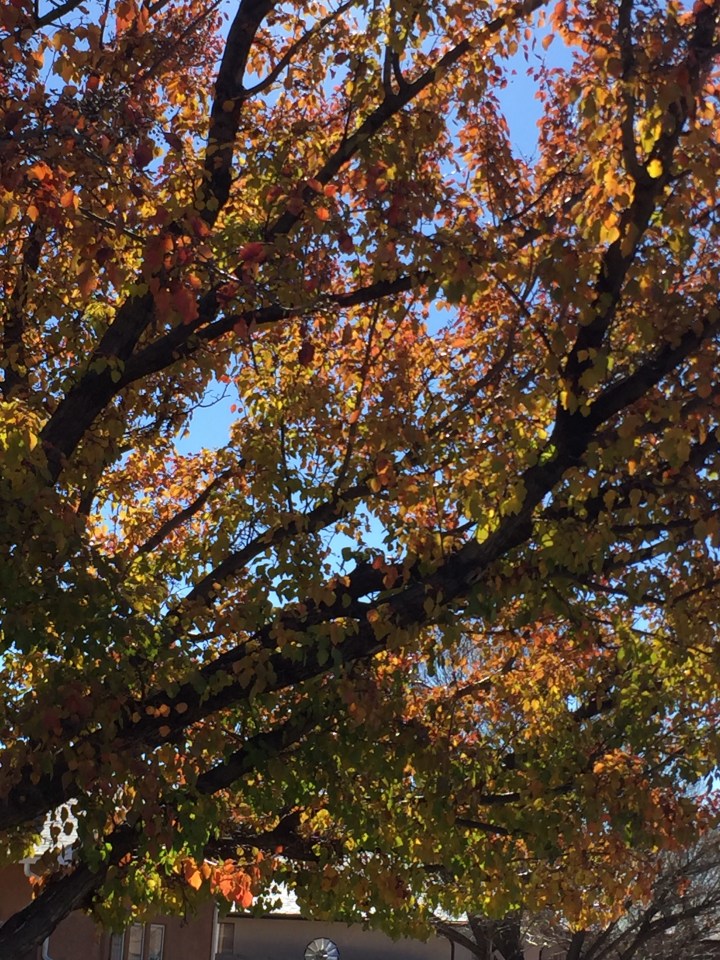
Each right turn reveals
deeper shades of gold;
each left turn, blue sky.
But the gold cannot stay:
Second by second, it changes,
slips away and then revives.
As I edge into the parking lot,
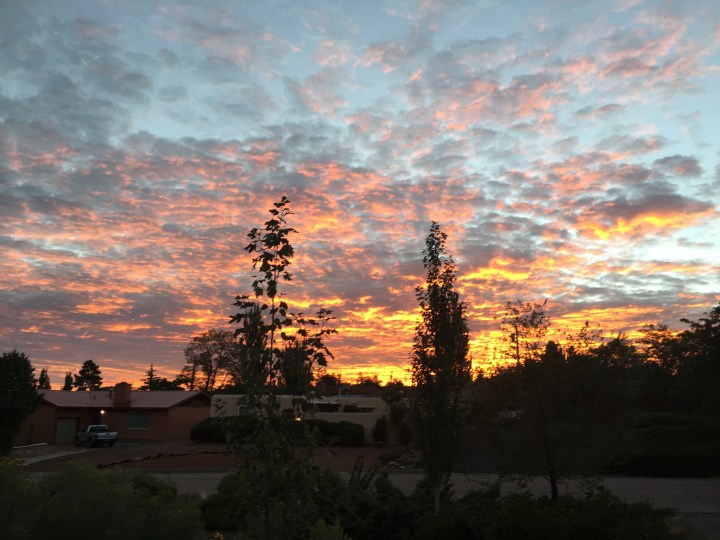
clouds now appear electrified
like lightning bolts,
wild and unphotographable.

Every living thing,
however comic or laughable,
seeks a day in the sun.
Even the earth, animated
by gravity, does not stay fixed in space,
but rotates, like a lover or dancer.
The sun, too, veers towards the earth
each day like a dove to her nestlings.
For what would the sunrise be
without our sweat rising to meet it,
without our strong lungs that exhale
invisible molecules into the atmosphere,
to draw color from the rays of sun?


I don’t know much about warfare
but I’ve visited the trenches.
Once I looked from afar but
I’ve crossed the embankment.
I don’t know if the enemy retreats,
but I know that when love
seems to ebb and flow
like the tide, or the faces of the moon,
it always resurfaces.
Like the gravity
that holds us together,
it’s always there.

I don’t know why
children go hungry;
I only know
that we must feed them.
I don’t know why
children are silent;
I only know
that we must sing to them.
Even the tightfisted boy
will join in the song.
Even if he is silent,
the way he stands now,
close to the others,
is the opening of a song.

To see the flowers in the trenches,
you must first roll up your sleeves.
Plant some seeds, maybe.
Carry some water.
Last summer,
despite the drought
and the tramping
of combat boots,
flowers
in the drought-stricken valleys
raised their throats
among the grasses
and sang.

If Jacob wrestled with his angel,
perhaps Mary wrestled with hers.
We know the resolution,
the acceptance. Yet there is
no moment by moment account,
no time lapse photography,
no witness. For acquiescence
is earned—the stillness
that follows the ripples
of the stone’s throw, the quiet
after the storm. Surely,
each painting, each canvas,
captures the moment after—
the message rehearsed,
the curtain drawn, light from afar
streaming in where, only
moments earlier, a shadow
obscured Mary’s downcast face.
“How can this be?”
Four simple words
to reflect the journey’s
unexpected twists and turns.
The tug and pull of life
towards light: sun and shadow’s
alternating rhythm.

While light streams in the doorway,
Mary sweeps the star dust trailed
by her visitor’s feet.
Likewise, every morning,
wings of rose descend on mesas:
Each daybreak, a mirror image
of the physics of light
dazzles on the horizon:
earth, a mirror
for the sun.
Where wildflowers grow skyward,
rock breaks itself
grain by grain
to provide the clay
through which the sun, our star,
gathers the green.

Think how the seed,
the stalk, and the blossom
are one. But how soon
the seed disperses
as it somersaults
from the stalk,
poised, windblown,
suspended on a breath.

Even in negative space—
the arc of the seed—
the hollow of the air
it transects—
blank canvas of space
between elbows and arms—
looms the shape of a dove.

If we could assemble
the missing pieces,
our lives could dovetail.
Remember the dove,
as she gathers straw
to line her nest,
disperses the seed.

Windblown fields
over the dark earth
shower gold
before falling.

Nothing is spotless for long,
even the lamb, newborn,
emerges tinged off-white,
matted with straw.
Yet darkness makes room
for that small pinpoint of light.

img_1730
On the hogbacks
where we hike,
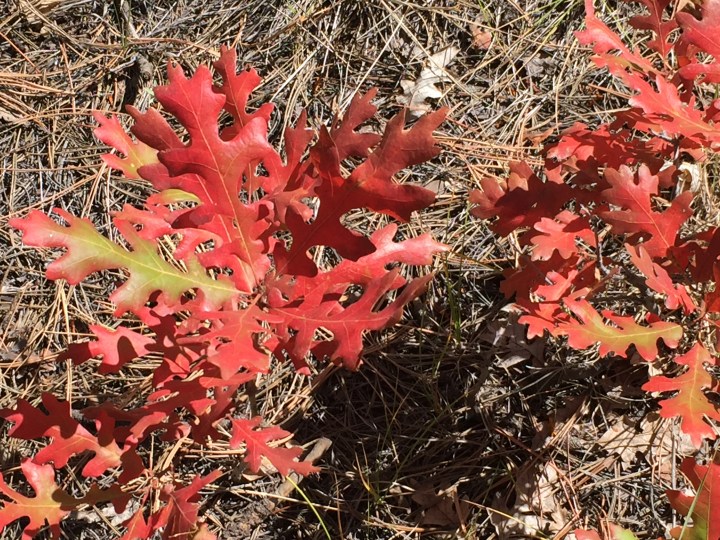
deciduous trees
drop their leaves.
So many shades of gold
suspended
from neighboring branches.

Prim evergreens,
the pinon and juniper
hang onto their green.
Frugality their motto,
they change costume
every three years or so,
replacing each needle
only as it wears through.

My dog, nose to the ground,
skirts cactus spines.
Some trees,
already bare,
admit sky’s blue,
their outlines stark
as a seamstress’
mannequin. Poised
between what is
and what may be,
one tree near my home
mirrors fall’s
indecisive weather,
half-green, half-red.
I cut and piece lines.
Words, stitched together,
recall autumn’s fire.

Inspired by “E tu Iddio” 
by Danilo Dolci.
“Bamb deega tond yiis toodo, 
la b zii tond base.”
Esaie 53:4, Matthieu 8:17.

You, Jesus, because You live

where sun-baked earth
declines nourishment,
You are lonelier, poorer than I:
I have seen You bent-backed
in a field cultivating soil,

I have seen You shape
clay into a manger,
I have seen You wince with pain 

from sickle cell anemia.

I am initiate in a land
where scars indicate family
and the people I meet
I call my Father’s children
for each person bears His image.

As an infant, Jesus,

on Your mother’s back,
You called to me: “Nazara,”

stretched out Your hands, 

happy for a smile.
Looking at me,
those dark eyes make me sad.

I used to think, Jesus,
that You hid from me:
I scanned countless crosses

and wooden benches
until I found You
playing soccer with friends.
You were barefoot like them

and I read whoever gives

even a glass of cold water

to the least of these 

does so unto You.

Jesus, when I was thirsty

You served me welcome-water
from a hollowed gourd.
The fibers of that gourd 

are sacred as the gold
of the Holy Grail.

Sometimes I’d like to witness 

the six-winged seraphim,
I’d like to hear
the cherubim singing,

but I know
I must go to the village: 

to open air markets

where You sell tomatoes,

to arabesque mosques 

where You pray,
to dusty streets
where You walk in Purdah.

Yes, I have searched heavens,

but I am no astrologer.
I have recognized a manger
by its odor of straw and animal.

For Your suffering troubles me,

to see You undernourished
and feverish moves me,
and if I wash Your running sores,

or comfort You if Your head
burns with malaria,
and offer You water
and the fruit You like:
it is my way of adoring You.

img_1191
I scraped
frost
from my windshield;
then drove east
to work.
Through poplars’
stripped branches
autumn’s gold
still shone.

img_1062
Blue spirals, water spilled
down a sinkhole, white
crepe paper dipped into a clear
cup of blue dye. An inkwell
in a wooden desk stained
my calloused fingers. Now
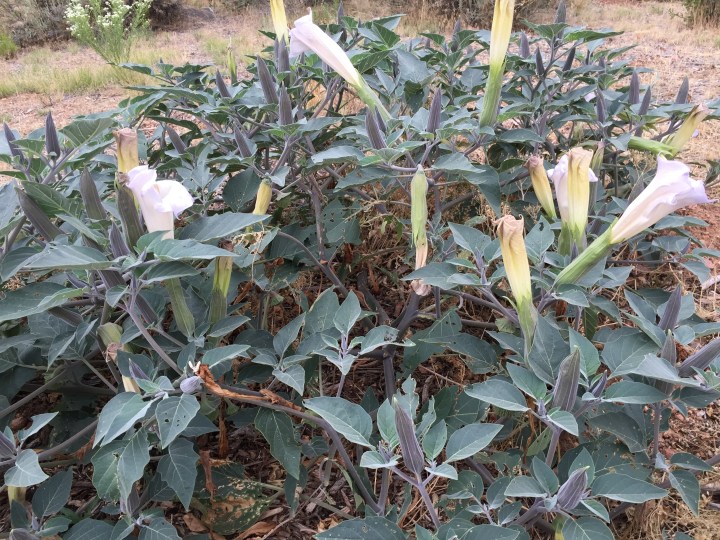
on the tightfisted Datura,
opaque funnel of white,
blue ink mists on tightly furled petals.

img_1508
Let the poem be
living sculpture,
each line
scaffolding
another.

Balance
line breaks.
Coil clay.
String words
like vertebrae.
Reed in headwind,
lash of whip,
fang, or quill,
powerless
to strike–
without
first
acquiescing
to the vertebrae’s
careful
execution.

image
How suddenly the storm ends.
Though rhythmic strands of rain
obscure blue mountains,
like static on a screen, still rain
soothes piñon-juniper scrubland
into quiet, sending silken streams
sidewise to water shoots,
blue-gray sky blanketing landscape.
And yet, how imperceptibly the storm
ends. Stray drops strike sidewalks now
and nudge, homeward, wet ankles.