It is not painted halos
that radiate grace—
Mary’s blood on the straw,
Joseph, carpenter turned midwife.

The room smelled of manure,
not evergreen and pine,
and even the barn animals
snorted and stomped their feet,
indifferent to his birth.

“He has lifted up the humble,”
Mary had sung to the angel.
yet now she lay in the straw,
like a heifer, to give birth.

Yet Mary loved this child
more dearly than life
and even had he been
Joseph’s offspring,
she would have loved him
just as much.

But as the child grew
this would become Mary’s burden
and Mary’s thorn,
that even on the Cross,
her son loved her no more, no less,
than he loved any other woman.
I doubted like Thomas as I wandered the road.
I could not see His face for my eyes were closed.
When Thomas saw His wounds, he came to believe:
Christ born in a stable, God’s love here conceived.

The ox and the shepherd worship in humble stall
To gaze on his meekness, on his love for us all
The angels in heaven their good news announce:
Christ the Savior is born here in Bethlehem town.

Oh, grant me the favor all evil to shun,
To serve him like Mary who nursed God’s own son,
With Mary and Martha to sit at his feet,
And with myrrh to anoint him like Mary Magdalene.

With shepherds and vagabonds, let us stand round his crib.
He welcomes the stranger for on this earth he lived
The life of an outcast, no pillow for his head,
But a stable his birthplace and straw for his bed.

The Romans carved wings
where no wings were,
adorning motionless statues
with heavy wings.
Had I wings to oar
through wild blue,
I would row through space
like a ship parting waves.
Wings would sweep
through space’s infinitude
marking time, a metronome
to stir heaven’s vault.
I would yield, suspended,
to the swing of the wind:
My aerie, you.

Halo of thorns
Draws flame,
Quickens fire—
For this He came.

Star’s breath
Inspires song;
Far-flung hosts
Hail God’s Son.

Calloused hands,
Rhythm of shepherds’
Crooks on cobbled
Streets: shards

Of the uncreated light.
Mary reflects on
Her Son’s life,
Birth to resurrection.

Now we enter
a season of reversals.
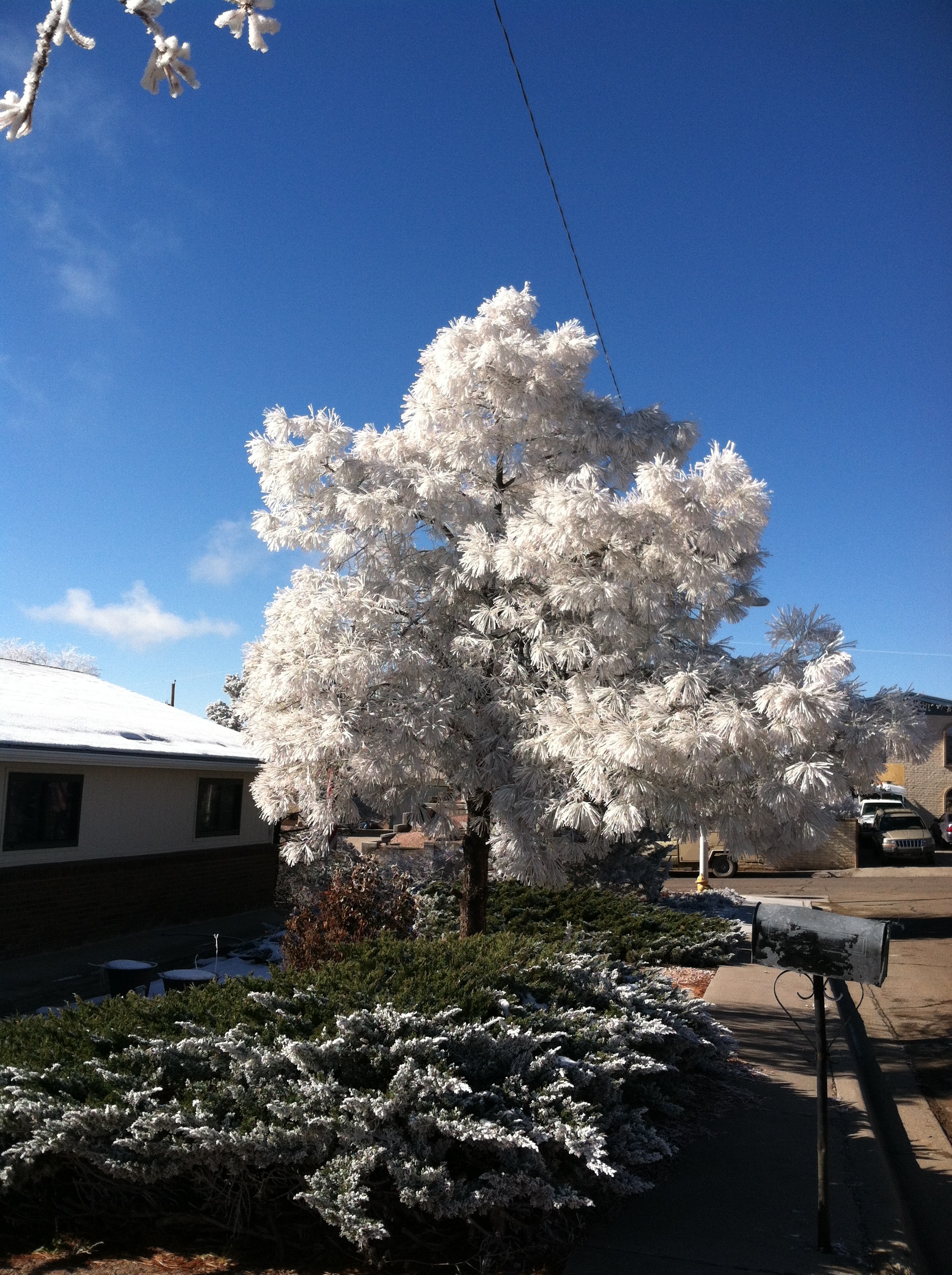
The last remaining leaves
of the honeysuckle bush
are ornamented in frost.
Jagged white fuzz
outlines brown oval-shaped pendants.
Even the pinon and juniper
exchange their evergreen status
for cloaks of white.
Yet as the cold deepens,
light lengthens,
dawn by dawn,
night by night.
The sun enters
its own reversal,
warming the earth,
despite snow and frost,
anticipating spring’s thaw.
Late December 1

The words were handed down
over space and time
torch to torch
lamp to lamp.
In the darkness
the words were carried
person to person
and flamed forth
when one person reached
another person.
Still so beautiful
whatever the language!
Flames of tongue
reach out.
Whether whispered
or in unison,
whether read silently
or aloud,
words find flame.
Darkness fell
and the word
set the world
on fire.

The folds in the robe
define. The arm
is suggested by the
sweep of the robe,
the sleeve
hollowed from wood.
The arc of the arm
holds a child’s head.
The woodgrain
of the mother’s breast,
rounded, rests against
Joseph’s chest.
The fold in the robe
defines. The turn
in the road is the way.
The vine twines
around the stake.
The fold in the robe
reveals the character
dormant until
the knife carves.

The shadows that cross
your face
cross mine.
When wind shakes leaves,
shadows shift.
Light lifts from your face
and reflects off
the curved surface
of bark and bract.

Underneath opaque faces
and the hint of a smile
lie shadows of craters;
beneath the bract,
the flower.

The heart swells onto the page,
the face, the eye;
yet hides.

Face reflects face
like moon reflects sun.
The contours of a line trace
thorn and blossom.
The deep bellows of the forge
breathe into us
like lungs.

For we are split infinitives,
diamond shard,
sparks of the forge.
We are burl and pearl.
Our world,
deep as a stone can fall,
wide as a wing can fly.

It was still November.
A child was born,
my brother.
Since my father’s
culinary repertoire
was slim, my mother,
in preparation for her stay
at la maternité,
had already deposited me
with her friend, a mother
whose children,
teenagers in lycée,
no longer believed in miracles.

One day, my mother’s friend
took my hand, and walked me
through Marseille’s twisting alleys,
to a church. Here
we descended a steep staircase,
dark as a cave entrance.
Even so, light reflected
off the glass partition
between the stairwell
and the display,
whose mysterious contents
lay shrouded in mystery.

Then my mother’s friend
removed a franc
from her purse
and deposited it neatly
into a machine
like a parking meter.
As she turned a lever,
I observed a miracle:
Lights flashed on
like angels appearing in the sky.
A mechanical whirr
accompanied the lights,
like the buzzing or humming
of a spring.

I was credulous,
trusting as a peasant,
as I saw the miniature fishmonger,
the carpenter,
the water bearer—
whose water never spilled,
the chimney sweep—
whose chimney dust
was painted on with a fine brush,
all treading lightly
toward the crèche,
bearing their gifts,
the fruit of their labor.

Even now, I find myself
depositing prayers
like coins,
as if to turn a lever,
expectant
of a miracle.

Little wonder the prophet spoke
of a coal burning his lips.
Word spreads like fire
and embers are carried from
neighbor to neighbor
coal by coal.
Even now our lips—
in new tongues—
mouth the ancient prayers.